

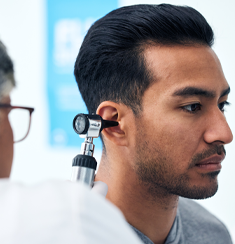
Your ears do more than let you hear — they keep you balanced and connected to the people around you. When something goes wrong, you want an ear specialist, not a generalist. Dr. Neeraj Suri trained in otology at the House Ear Institute in Los Angeles — one of the world’s foremost ear centres — and has spent over 20 years treating ear disease in Gujarat, from common infections to complex ear microsurgery and cochlear implants.
At Evara Hospital every ear patient is assessed with microscope/endoscope examination and, where needed, same-day hearing tests (audiometry, tympanometry, BERA/OAE) in our own audiology lab. Dr. Neeraj Suri, the best ear-nose-throat specialist in Ahmedabad, treats a wide range of issues.
Being the best nose specialist doctor in Ahmedabad, we welcome you to Evara Hospital to treat your different problems under one roof.
As the best ear nose specialist in Ahmedabad, we bring you nothing but the best care. Through the best programs, we provide patient-centred ENT care and enhanced diagnosis. Using evidence-based medicine and effective methods, She is highly trained in handling different situations with ease and care.
When surgery is needed, Dr. Suri performs precise, minimally invasive procedures — many through the ear canal with no external cut:
Do not ignore ear pain or discharge, sudden hearing loss (this is an emergency — see a specialist within 48 hours), persistent ringing, repeated infections, a feeling of blockage, or dizziness. Early treatment protects your hearing; delayed treatment can lead to permanent loss or serious complications.
When it comes to nose, throat and ear specialist doctor in Ahmedabad, Dr. Neeraj Suri is the customer’s first choice. Wondering why? Well, here are the major reasons:
While some people fail to take care of themselves, some think there is nothing they can do about them. However, this is where Dr. Neeraj Suri comes to help you with the best treatment plans for your ear, nose and throat.
At Evara Hospital, we offer the best and most tailored solutions to all patients dealing with ENT problems. As the best ear doctor in Ahmedabad, we use the newest methods and technology to ensure accurate results.
We make sure that our operations and plans fit every patient’s goals, budget, health and lifestyle. Besides, we always explain the procedures, related expenses and timelines so you know precisely what to expect during your visit to Evara Hospital.
Call +91 95122 68282 or book online to see Dr. Neeraj Suri at Evara Hospital, Sector-21 Gandhinagar — 25 minutes from Ahmedabad. As the best ear doctor in Ahmedabad, we use the newest methods and technology to ensure accurate results.
Copyright © 2025. All Rights Reserved.