
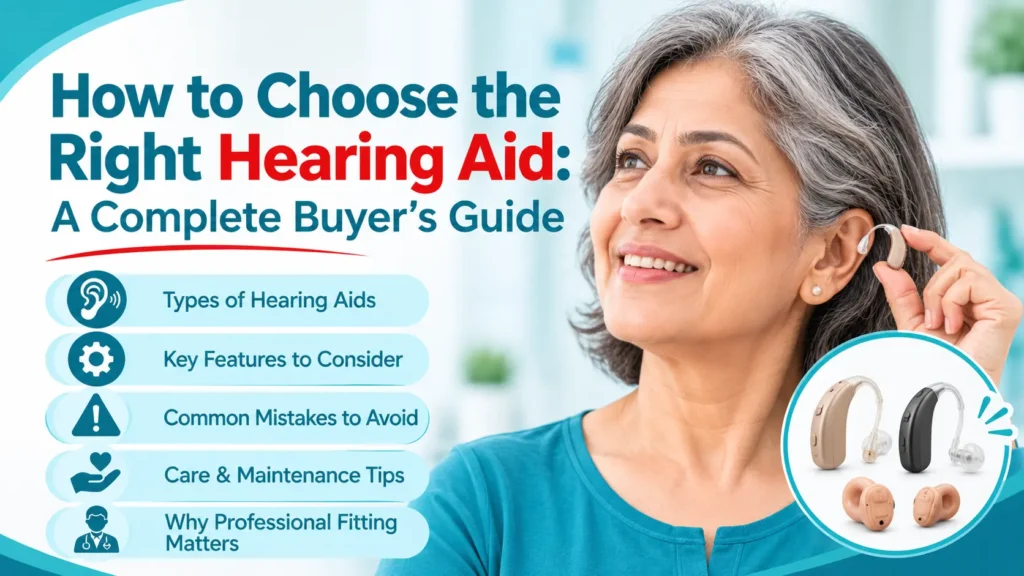
If a hearing test has shown you need a hearing aid, the next step can feel overwhelming – dozens of brands, styles, features and prices, and plenty of pushy sales pitches. The truth is that the ‘best’ hearing aid is not the most expensive or the most advertised; it is the one correctly matched to your hearing, your lifestyle and your ears, and properly fitted. Knowing how to choose a hearing aid wisely saves you money and disappointment, and genuinely changes how well you hear.
This buyer’s guide explains the main types of hearing aid, the features that actually matter, the mistakes to avoid, and why professional testing and fitting matter more than the brand on the box. It also covers the signs it is time for a test, whether you need one aid or two, how to care for your device, and what the options are when a hearing aid alone is not enough – so you make a confident, informed choice rather than an expensive guess.
First, why professional fitting matters more than brand
Here is the single most important thing to understand: a hearing aid is a prescription device, not an off-the-shelf gadget. The same expensive hearing aid can be life-changing for one person and useless for another, depending entirely on whether it is programmed to their exact hearing loss and fitted correctly.
This is why buying a device online or from a shop without a proper hearing test so often disappoints. A qualified audiologist or ENT first measures exactly what you can and cannot hear, then selects and precisely tunes the device to fill those gaps. The expertise behind the fitting matters far more than the logo – which is why choosing the best Hearing Aids In Ahmedabad starts with choosing the right professional, not the right advertisement.
The main types of hearing aid
Hearing aids come in several styles, each with trade-offs between visibility, power and ease of handling. The right style depends on your degree of hearing loss, dexterity and preferences.
- Behind-the-ear (BTE) – sits behind the ear with a tube into the canal; powerful, reliable and suitable for almost all levels of hearing loss, including severe.
- Receiver-in-canal (RIC) – a discreet, popular modern style; natural sound, good for mild to moderate-severe loss.
- In-the-ear (ITE) – custom-moulded to fill the outer ear; easier to handle, good for mild to moderately-severe loss.
- In-the-canal / completely-in-canal (ITC/CIC) – very discreet, sitting inside the canal; best for mild to moderate loss and good dexterity.
- Invisible-in-canal (IIC) – the most hidden option, but small and less powerful, suited to milder losses.
Smaller and more invisible is not always better – tiny aids are harder to handle, have smaller batteries and less power. The right choice balances discretion with what your hearing actually needs.
Features that actually matter
Modern hearing aids come loaded with features, but only some make a real daily difference. Focus on these rather than paying for options you will never use:
- Noise reduction and directional microphones – help you follow conversation in noisy places like restaurants and gatherings; genuinely useful.
- Rechargeability – no fiddly batteries; convenient, especially for older users.
- Bluetooth connectivity – stream calls, TV and music directly; valuable for phone-heavy lifestyles.
- Feedback cancellation – stops the annoying whistling.
- Number of channels/programs – more adjustability for different environments.
- Telecoil – useful in public loop systems.
Match the features to your life. A socially active person benefits from strong noise handling and Bluetooth; someone mostly at home may not need the top tier at all – and a good professional will tell you so honestly rather than upselling.
Matching the hearing aid to your lifestyle
The best device for you depends on how you live. Someone who attends meetings, dines out and uses the phone constantly needs excellent noise management and connectivity. Someone whose main wish is to hear family at home and the television clearly has simpler needs and can spend accordingly.
Dexterity and eyesight matter too – if small controls are difficult, a larger rechargeable style is kinder to use. Being honest about your real daily listening situations, rather than chasing the newest technology, is how you avoid overpaying for features you will never notice.
Common mistakes to avoid
Many people end up with a drawer full of unused hearing aids because of avoidable mistakes. Steer clear of these:
- Buying without a proper hearing test – the commonest and costliest error.
- Choosing by price or brand alone – the fitting matters more than the label.
- Picking the tiniest aid regardless of your hearing – it may lack the power you need.
- Skipping the trial and follow-up – the brain needs time to adjust, and the aid needs fine-tuning over the first weeks.
- Falling for ‘free’ or scam offers – unqualified sellers and miracle devices waste money and hearing.
- Giving up too soon – early sounds feel strange; with proper support most people adapt well.
The fitting and adjustment process
Getting a hearing aid is the start, not the end. After testing, the device is programmed to your hearing and fitted comfortably. Then comes the most important part – a period of gradual adjustment, where your brain relearns sounds it had stopped hearing, supported by follow-up visits to fine-tune the settings.
This is why buying from a professional who provides proper after-care beats a one-off purchase from a shop. As the Hearing aid specialist in Ahmedabad at Evara, the team guides each patient through fitting, trial and adjustment so the device actually delivers the hearing improvement it promises – and keeps delivering it over the years.
Signs you may need a hearing aid – and why not to delay
Many people put off getting their hearing checked for years, often because the loss creeps in so gradually that they adapt without realising. Watch for these everyday signs that it is time for a test:
- Frequently asking people to repeat themselves, or feeling that others ‘mumble’.
- Turning the television or phone volume up higher than others find comfortable.
- Struggling to follow conversation in noisy places like restaurants or gatherings.
- Difficulty hearing on the phone, or missing the doorbell or notifications.
- Feeling tired or withdrawn after social events from the effort of straining to hear.
Delaying matters more than people think. Untreated hearing loss does not just make life harder socially; research links it to faster cognitive decline, low mood and social isolation, because the brain gradually loses the ability to process sounds it no longer receives. Acting early, rather than waiting until the loss is severe, makes adjustment to a hearing aid easier and protects long-term listening skills – another reason a timely test with a best ear doctor in Ahmedabad is worthwhile.
Understanding the cost – and what you are paying for
Hearing aid prices vary widely, and the range can be confusing. The difference between budget and premium devices usually comes down to the sophistication of the technology – how well they separate speech from background noise, how many listening programs they offer, and features like rechargeability and Bluetooth. It is not simply a case of ‘more expensive is better for everyone’.
The honest truth is that the right price is the one that matches your actual listening needs. A very social, working person may genuinely benefit from premium noise handling; someone with quieter routines may hear beautifully with a mid-range device. What you should never economise on is the hearing test, the fitting and the follow-up care – because a well-fitted mid-range aid outperforms a poorly-fitted premium one every time. A good professional helps you spend where it counts and not where it does not.
One hearing aid or two?
If both ears have hearing loss, a common question is whether one aid will do. For most people with loss in both ears, two hearing aids are genuinely better than one – because we hear with two ears for good reason. Two aids let the brain locate where sounds come from, understand speech far better in noise, and give a more balanced, natural sound.
Using only one aid when both ears need help often leaves the unaided ear straining and can let its listening skills fade over time. There are exceptions – some patterns of hearing loss genuinely suit a single aid – but the decision should follow the hearing test, not the budget alone. An honest professional will tell you clearly whether one or two will serve you best, and why, rather than simply selling more.
When a hearing aid is not enough
For most hearing loss, a well-fitted hearing aid is the answer. But in cases of severe or profound hearing loss, where even powerful hearing aids cannot deliver clear speech, there are further options that can transform hearing – and it is important to know they exist rather than assume nothing more can be done.
Chief among these is the cochlear implant, a device that bypasses the damaged part of the ear to stimulate the hearing nerve directly, restoring useful hearing for people whom hearing aids can no longer help. The crucial point is that a proper assessment identifies when someone has outgrown hearing aids and would benefit from an implant instead – which is why expert evaluation matters. As a trusted best ear doctor in Ahmedabad, Dr. Neeraj Suri assesses the full range of options, so no patient is left struggling with an aid that cannot meet their needs when a better solution is available.
Caring for your hearing aid so it lasts
A hearing aid is an investment, and a little daily care keeps it working well for years. Simple habits prevent the most common problems, which are usually moisture and wax rather than genuine faults:
- Keep them dry – remove before bathing or swimming, and use a drying kit, especially in humid weather.
- Clean gently every day with a soft dry cloth and the brush provided; keep wax filters clear.
- Store safely in their case, away from heat, pets and children, with the battery door open overnight.
- Handle over a soft surface so a dropped aid is not damaged.
- Attend regular check-ups so the device can be cleaned professionally and retuned as your hearing changes.
If a hearing aid ever sounds weak or dead, it is far more often wax, moisture or a flat battery than a real fault – so a quick clean or a visit to your Hearing aid specialist in Ahmedabad usually solves it. Good care genuinely extends the life and performance of the device.
Choose the Right Hearing Aid with Expert Guidance
Do not buy a hearing aid blind. For a proper hearing test, honest advice and expert fitting, consult the team at Evara Hospital with Dr. Neeraj Suri, a trusted best ear doctor in Ahmedabad. Call +91 95122 68282 or book online; evening and Sunday OPDs available, with a visiting OPD in Shahibaug, Ahmedabad.
Author & Medical Review
Medically reviewed by Dr. Neeraj Suri (she/her), MS (ENT) – Ex-Fellow, Stanford University & House Ear Institute, Los Angeles; Ex-Associate Professor of ENT, GMERS Medical College, Gandhinagar; author of three books on the ear and hearing.
FAQs
Q. What is the best type of hearing aid?
A. There is no single best type – it depends on your degree of hearing loss, ear shape, dexterity and lifestyle. Behind-the-ear and receiver-in-canal styles suit most people; the right choice is decided after a proper hearing test and fitting.
Q. Is a more expensive hearing aid always better?
A. No. Correct fitting and programming matter far more than price or brand. An expensive aid that is poorly fitted performs worse than a mid-range one tuned properly to your hearing.
Q. Can I just buy a hearing aid online?
A. It is not advised. Without a hearing test and professional fitting, the device is unlikely to match your hearing, which is why so many online purchases end up unused.
Q. How long does it take to get used to a hearing aid?
A. Usually a few weeks. The brain needs time to relearn sounds, and the aid is fine-tuned over follow-up visits. Sticking with it through this period is key to success.
Q. Which features do I really need?
Noise reduction and directional microphones help most people; rechargeability and Bluetooth add convenience. Match features to your lifestyle rather than paying for the top tier automatically.