
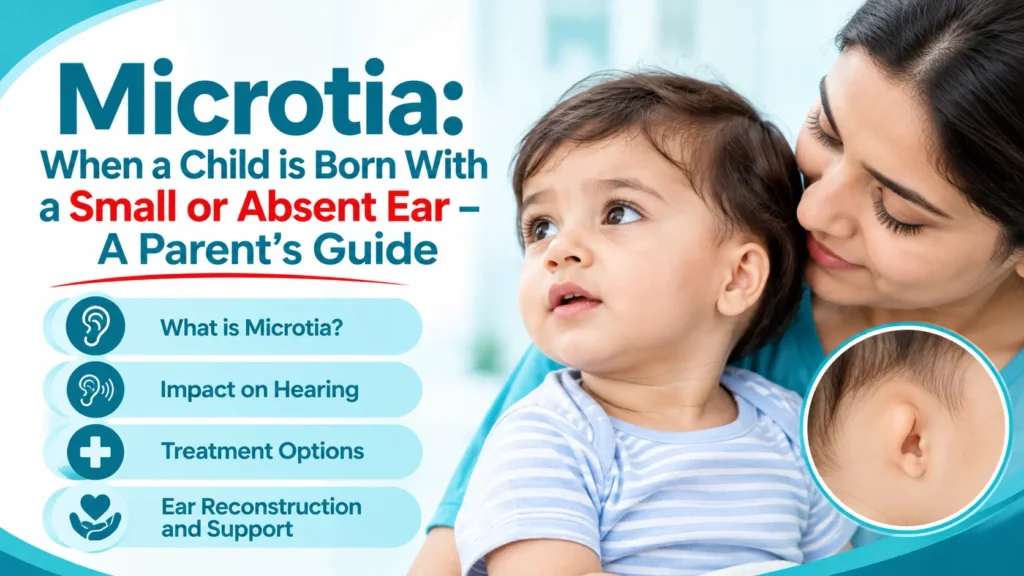
For a parent, noticing that a newborn’s ear has not formed normally is deeply worrying. This condition – a small, underdeveloped or absent outer ear – is called microtia, and while it is uncommon, it is well understood and very treatable. Understanding microtia (small or absent ear) – what it means for a child’s hearing, appearance and development, and the options for ear reconstruction – helps families move from worry to a clear, hopeful plan.
This guide explains what microtia is, how it affects hearing, when and how it is treated, and what ear reconstruction involves – so parents know exactly what lies ahead and what support is available.
What is microtia?
Microtia means an outer ear (the pinna) that is underdeveloped or, in its complete form (anotia), absent. It is present from birth, usually affects one ear, and can range from a slightly small ear to just a small remnant of tissue. It is often accompanied by a narrow or absent ear canal, which affects hearing on that side.
Microtia is not caused by anything parents did or did not do during pregnancy – it is a difference in how the ear formed very early on. It is sometimes linked with other conditions but very often occurs on its own in an otherwise healthy child.
How microtia affects hearing
Because microtia usually comes with a narrow or closed ear canal, the affected ear typically has a conductive hearing loss – sound cannot travel normally to the inner ear. The crucial point for parents is that the inner ear and hearing nerve are usually normal, so the potential to hear is there; the sound simply cannot get through the blocked outer pathway.
When only one ear is affected and the other hears normally, children usually develop speech well, but they can struggle with locating sound and hearing in noise. When both ears are affected, early hearing support is essential for speech development. This is why a prompt hearing assessment – including specialised newborn tests – is the first and most important step, well before any thought of surgery.
The first priority: hearing, early
Appearance understandably worries parents most at first, but the specialists’ first priority is always hearing, because that is what affects a child’s speech and learning. A full hearing assessment establishes exactly how much the child hears in each ear.
Where hearing support is needed – especially if both ears are affected – options such as a bone-conduction hearing device can route sound to the normal inner ear, giving the child clear access to speech during the vital early years. Getting this right early is far more important to a child’s development than the timing of any cosmetic reconstruction, and an experienced best ear doctor in Ahmedabad will always address it first.
Ear reconstruction: the options
Rebuilding the outer ear – ear reconstruction – is usually carried out later in childhood, when the ear has grown closer to adult size and the child can take part in decisions, typically around school age or later. There are two main approaches:
- Rib cartilage reconstruction – the surgeon sculpts a new ear framework from the child’s own rib cartilage and places it under the skin, creating a natural, living ear over a staged series of operations. A long-established, durable method.
- Medpor (synthetic framework) reconstruction – uses a biocompatible implant framework covered with the child’s own tissue, often achievable in fewer stages.
- Prosthetic ear – a custom-made, highly realistic external ear attached with adhesive or small implants, a non-surgical or implant-supported option.
- Canal and hearing surgery – separately, where appropriate, procedures may help the hearing side of the problem, carefully planned alongside the reconstruction.
The right path depends on the child, the type of microtia and the family’s wishes. As an experienced Ear Reconstruction Doctor in Ahmedabad, Dr. Neeraj Suri guides families through these options with a plan tailored to each child rather than a one-size-fits-all approach.
Timing and what the journey looks like
Microtia care is a journey over several years, not a single event, and knowing the shape of it reassures families. In infancy, the focus is entirely on hearing assessment and support. Through early childhood, hearing and development are monitored and supported.
Ear Reconstruction Surgery in Ahmedabad is then planned for later childhood, when the ear and rib cartilage are big enough and the child is ready. Reconstruction itself is usually staged over more than one operation, with time to heal between them. Throughout, the aim is a natural-looking ear and the best possible hearing, achieved at the right time for that particular child.
Supporting your child emotionally
Beyond the medical plan, children with microtia may face questions or comments from peers, and parents naturally worry about confidence and self-esteem. The good news is that with early hearing support, a well-timed reconstruction and a supportive family, children with microtia grow up to thrive.
Talking openly and age-appropriately, connecting with other families through support groups, and working with a caring specialist team all make a real difference. A child who hears well and feels supported copes remarkably well – and today’s reconstruction results can be genuinely natural-looking, which helps enormously as they grow.
The grades of microtia
Microtia is not one single condition – it ranges from mild to complete, and understanding the grade helps parents know what to expect. Doctors usually describe it in broad grades:
- Grade 1: a slightly smaller ear with most normal features present; the ear canal may be narrowed.
- Grade 2: a partially developed ear, often missing some structures, commonly with a narrowed or absent canal.
- Grade 3: the classic form – only a small peanut-shaped remnant of cartilage and an earlobe, usually with no ear canal.
- Grade 4 (anotia): complete absence of the outer ear.
The grade influences both the hearing picture and the reconstruction plan, but it does not change the reassuring fundamentals: the inner ear is usually normal, hearing can be supported, and the outer ear can be rebuilt. Your specialist will explain exactly where your child sits and what it means for their individual plan.
Will my child’s speech and development be affected?
This is the question that worries parents most, and the answer is genuinely reassuring. When only one ear is affected and the other hears normally – the most common situation – children almost always develop speech and language normally, because one good ear is enough for the brain to learn language well.
The areas where single-sided hearing can create mild challenges are locating where sounds come from and hearing clearly in very noisy settings, such as a busy classroom. These are manageable with simple strategies – favourable seating at school, teacher awareness, and hearing support where helpful. When both ears are affected, early hearing support becomes essential, and with it children also develop speech well. The key throughout is early assessment, so that whatever support is needed is in place during the crucial language-learning years.
How the hearing support works
When a child with microtia has a blocked or absent ear canal, sound cannot travel the normal way – but there is an elegant solution. Because the inner ear and hearing nerve are usually healthy, sound can be delivered to them by bone conduction, bypassing the blocked canal entirely.
A bone-conduction device picks up sound and sends it as gentle vibrations through the skull bone directly to the working inner ear. In young children this is often worn on a soft headband, needing no surgery, so hearing support can begin early and painlessly; later, if appropriate, an implanted version can be considered. For families, the reassuring message is that effective hearing is almost always achievable, even when the outer ear and canal have not formed – the pathway to the hearing nerve simply takes a different, well-established route.
Choosing the right team for your child
Microtia care spans hearing assessment, hearing support and, later, reconstructive surgery – so the most important thing a family can do is find an experienced ENT and reconstructive specialist who can guide the whole journey rather than treating pieces of it in isolation. Continuity matters, because decisions about hearing and reconstruction are interlinked and unfold over years.
Look for a specialist who prioritises hearing first, explains each option honestly, and has real experience with ear reconstruction techniques. As an experienced Ear Reconstruction Doctor in Ahmedabad, Dr. Neeraj Suri supports families from the first newborn hearing assessment through to reconstruction at the right age – a single, consistent plan built around each child. For parents, having one trusted team who knows the whole story removes much of the stress and uncertainty, and ensures nothing important is missed along the way.
Common questions parents ask at the first visit
Families arrive with the same understandable worries, and addressing them early brings real relief. Among the most frequent:
- ‘Did we cause this?’ – No. Microtia is a difference in early development, not the result of anything you did or did not do.
- ‘Will the other ear be affected too?’ – Usually microtia affects one ear only, and the other develops normally.
- ‘Can it be fixed?’ – Yes – hearing can be supported and the outer ear reconstructed; it is a well-trodden path.
- ‘When do we start?’ – Hearing assessment starts in infancy; reconstruction is planned for later childhood.
- ‘Will my child be okay?’ – With the right support and care, children with microtia grow up to live full, confident lives.
Having these questions answered clearly by an experienced Ear Reconstruction Doctor in Ahmedabad is often the moment families move from fear to a calm, hopeful plan – which is exactly what a first consultation is for.
What results can families expect?
After everything, parents want to know what the end result really looks like – and modern ear reconstruction has come a long way. A well-constructed ear using the child’s own cartilage is living tissue that grows with them, sits naturally, and in most cases is remarkably close in appearance to the other ear, allowing children to wear glasses, tie their hair back and feel confident.
It is honest to say that reconstruction is a staged journey and results take time and more than one procedure to achieve – this is not an overnight fix. But the combination of early hearing support and a skilled, well-timed reconstruction gives children both the ability to hear and an ear they feel comfortable with. Families who approach it step by step, with an experienced team, are usually delighted with how far their child comes – and, most importantly, with how confident and capable their child grows up to be.
A Clear, Caring Plan for Your Child’s Ear
If your child has microtia, expert guidance turns worry into a clear plan – starting with hearing and continuing to reconstruction at the right time. Consult Dr. Neeraj Suri – a trusted best ear doctor in Ahmedabad and ear reconstruction surgeon – at Evara Hospital. Call +91 95122 68282 or book online; evening and Sunday OPDs available.
Author & Medical Review
Medically reviewed by Dr. Neeraj Suri (she/her), MS (ENT) – Ex-Fellow, Stanford University & House Ear Institute, Los Angeles; Ex-Associate Professor of ENT, GMERS Medical College, Gandhinagar; author of three books on the ear and hearing.
FAQs
Q. What causes microtia?
A. Microtia is a difference in how the outer ear formed very early in development. It is not caused by anything parents did during pregnancy, and it often occurs on its own in an otherwise healthy child.
Q. Can a child with microtia hear?
A. Usually the inner ear and hearing nerve are normal, so the potential to hear is there – but a narrow or closed canal blocks sound, causing conductive hearing loss. Hearing support can route sound to the working inner ear.
Q. What is treated first – hearing or appearance?
A. Hearing, always. Because hearing affects speech and learning, assessment and support come first in infancy, while ear reconstruction is planned for later childhood.
Q. When is ear reconstruction done?
A. Usually in later childhood – around school age or later – when the ear has grown close to adult size and the child can take part in the decision. It is typically staged over more than one operation.
Q. What are the reconstruction options?
Reconstruction using the child’s own rib cartilage, a synthetic (Medpor) framework, or a custom prosthetic ear. The right choice depends on the child, the type of microtia and the family’s wishes.