
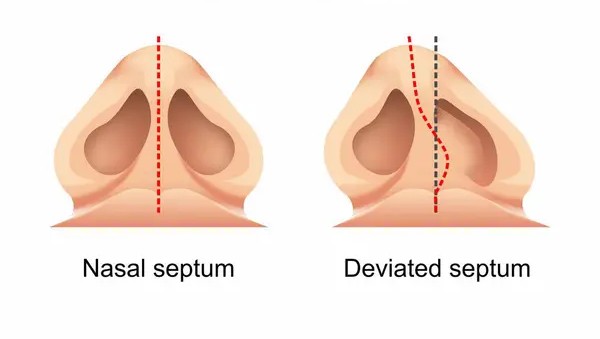
If you breathe well through only one nostril, snore every night, or catch sinus infection after sinus infection, a bent nasal septum may be the hidden cause. The good news is that endoscopic nose surgery in Ahmedabad can straighten it in under an hour, with no external cuts and a quick recovery. In this guide, Dr. Neeraj Suri explains what a deviated septum really is, when it needs treatment, and exactly what septoplasty involves — so you can decide with confidence rather than guesswork.
What Is a Deviated Septum?
The septum is the thin wall of cartilage and bone that divides your nose into two passages. In most people it sits slightly off-centre and causes no trouble at all. In others it is bent far enough to block one side, dry out the other, and disturb the way the sinuses drain. Some deviations are present from birth; many follow an injury — a childhood fall, a sports knock, or an accident, sometimes years earlier and long forgotten.
Signs You Should Not Ignore
A deviated septum rarely hurts, so it is easy to live with for years without realising it is the problem. Watch for these signs:
- Blockage on one side, or alternating sides, that sprays never fully clear
- Snoring and mouth-breathing, worse lying on one side
- Repeated sinus infections on the blocked side
- Nosebleeds from the dry, exposed side
- Facial pressure, headaches, or reduced sense of smell
- Breathlessness during exercise
How a Deviated Septum Is Diagnosed
Diagnosis is quick and painless. A nasal endoscopy — a slim camera passed into the nose after a numbing spray — shows the deviation clearly, along with anything else adding to the blockage, such as enlarged turbinates or nasal polyps. If sinus surgery may be combined, a CT scan is added to map the sinuses. Seeing the inside of your own nose on screen usually makes the treatment plan far easier to understand.
Endoscopic Nose Surgery in Ahmedabad: The Septoplasty Procedure
Not every deviation needs surgery. Septoplasty is recommended only when the bend causes symptoms that medicines cannot control, or when the nose must be opened to allow sinus surgery or a comfortable CPAP fitting for sleep apnoea. When it is needed, the modern procedure is straightforward:
- Performed under general anaesthesia, taking about 45–60 minutes.
- Done entirely through the nostrils — there are no external cuts and no facial bruising.
- The bent cartilage and bone are reshaped or trimmed while the lining is carefully preserved.
- Often combined with turbinate reduction or sinus surgery in the same sitting.
- Soft internal splints, rather than painful packing, are usually placed for a few days.
Recovery Week by Week
Expect a blocked, stuffy nose for the first week, which eases once the splints come out at day five to seven. Most people return to desk work within three to five days and to exercise at two to three weeks. Breathing improves noticeably by two to three weeks and fully by six to eight, as the last of the swelling settles.
Septoplasty vs Rhinoplasty
Septoplasty corrects the inside of the nose to improve breathing; rhinoplasty reshapes the outside for appearance. When a patient wants both, they are done together as a septorhinoplasty. If your concern is purely how the nose looks, that is a separate, cosmetic conversation.
Why Choose Evara Hospital for Sinus Surgery in Ahmedabad
Because the nose, sinuses and breathing are all connected, a surgeon who treats the whole system gets the best result. Dr. Neeraj Suri has over 20 years of experience in endoscopic nose and sinus surgery in Ahmedabad, works with high-definition endoscopy, and combines septoplasty with allergy and sinus care so the problem is solved at its root rather than patched. All of it happens under one roof, with day-care or one-night stays for most patients.
What Causes a Septum to Bend?
Understanding why your septum is deviated helps make sense of the treatment. Broadly, there are two routes. The first is developmental: as the nose and face grow through childhood and adolescence, the cartilage and bone can grow unevenly, leaving the septum off-centre by adulthood — with no injury ever involved. The second is trauma. A knock to the nose during sport, a fall as a child, a road accident, or even a difficult delivery at birth can shift the septum, and because the nose heals quickly, the deviation is often forgotten until breathing problems appear years later.
It is worth knowing that a deviated septum does not correct itself over time, and it will not respond to sprays, exercises or home remedies, because the obstruction is structural. This is precisely why so many people struggle for years with sprays that give only brief relief before the blockage returns.
What to Expect on the Day of Surgery
Knowing the day’s flow removes most of the anxiety. You will be asked to fast for a few hours beforehand and to stop any blood-thinning medicines as advised. After admission and a pre-operative check, the surgery is done under general anaesthesia, so you feel nothing during the procedure. Because everything is done through the nostrils, you wake with no bandages on your face and no bruising.
- Soft internal splints, not painful gauze packing, are usually placed to support healing
- You can go home the same day or after one night in most cases
- Expect a blocked, stuffy feeling for a few days — this is swelling, not a failed surgery
- Simple painkillers control any discomfort; strong opioids are rarely needed
Combining Septoplasty With Sinus and Turbinate Surgery
A bent septum rarely travels alone. It often comes with enlarged turbinates — the structures that warm and humidify air — or with chronic sinus disease. Correcting only the septum while leaving swollen turbinates or blocked sinuses often disappoints. That is why an experienced surgeon assesses the whole nasal airway and, where needed, combines septoplasty with turbinate reduction or endoscopic sinus surgery in a single anaesthetic. One operation, one recovery, and a properly open airway is far better than repeated partial fixes.
How Long Do the Results of Septoplasty Last?
This is one of the most common questions, and the answer is reassuring: for the great majority of patients, septoplasty is a one-time, permanent solution. Once the septum is straightened and healed, it does not slowly bend back. The clear breathing you gain is lasting, provided other conditions such as allergy or recurrent sinus disease are also managed, since those can cause the lining to swell again even with a perfectly straight septum. This is why the best long-term outcomes come from treating the whole nasal airway together, rather than the septum in isolation.
Is Septoplasty Worth It?
For someone who has spent years fighting a blocked nose, disturbed sleep and repeated sinus infections, a single short procedure that permanently restores clear breathing is usually well worth it. Beyond comfort, better nasal breathing improves sleep quality, reduces snoring, lessens the frequency of sinus infections, and often improves the sense of smell and taste. Many patients say afterwards that they had simply forgotten what it felt like to breathe freely through both nostrils — and wished they had done it sooner.
A Final Word on Breathing Freely
If a blocked nose has quietly shaped your daily life — poor sleep, low energy, constant sinus trouble — it is easy to assume that is simply how your nose is. Very often it is not, and a straightforward, well-planned procedure can change it for good. The key is an accurate diagnosis of the whole nasal airway, so that the septum, turbinates, sinuses and any allergy are all addressed together rather than one at a time.
Breathe Freely Again — Book Your Nose Consultation
Tired of a blocked nose, restless snoring nights, or endless sinus infections? Don’t keep guessing at the cause. Book a nasal endoscopy with Dr. Neeraj Suri at Evara Hospital and get a clear answer and a plan. Call +91 95122 68282 or book online today — evening and Sunday OPDs are available for patients across Ahmedabad and Gandhinagar.
Author & Medical Review
Dr. Neeraj Suri, MS (ENT) — Ex-Fellow, Stanford University & House Ear Institute, Los Angeles; Ex-Associate Professor, GMERS Medical College, Gandhinagar. Medically reviewed by Dr. Neeraj Suri.
FAQs
Q. Is septoplasty painful?
A. Most people feel mild discomfort and blockage for about a week rather than sharp pain, and simple painkillers control it well.
Q. Will septoplasty change the shape of my nose?
A. No — it works inside the nose to improve breathing. Changing the external shape requires rhinoplasty, which can be combined if you wish.
Q. Can a deviated septum come back after surgery?
A. Recurrence needing another operation is uncommon; a small residual bend can occasionally remain but rarely causes symptoms.